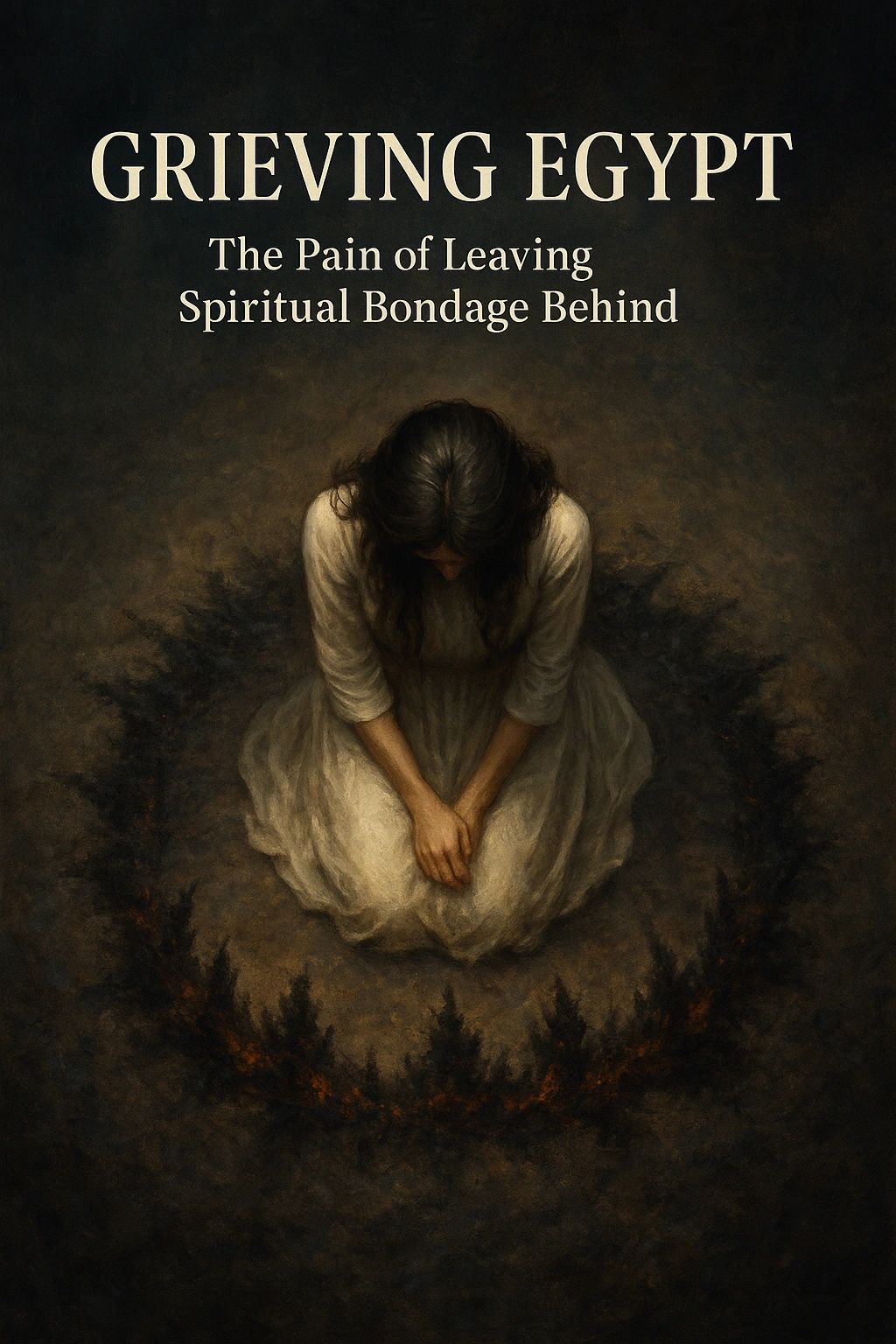
Grieving Egypt: The Pain of Leaving Spiritual Bondage Behind
What if I told you that getting free can break your heart?
That the place you’re called to leave behind can still feel like home, even when it was a prison?
This isn’t just about Egypt. It’s about every place you’ve ever mistaken for safety.
I remember grieving my run-down trailer, the cold drafts that rattled the thin walls at night, the stale smell of liquor in the carpet, the clutter that felt like a fortress around me. It was killing me, but it was home in a twisted way. Because healing felt like peeling back a wound that never fully healed. Every step forward was raw and stinging. Letting go was a kind of death, each inhale catching like a sob in my throat. And sometimes I didn’t know how to grieve what was without feeling it settle back into my bones, like the ghosts of that life still hovered in the shadows, waiting for me to slip back in.
Most people don’t talk about the grief that comes with freedom.
We love the idea of deliverance, the Red Sea moment, the promised land, the songs of victory.
But what about the ache that hits when you finally leave Egypt?
What about when you walk away from a place that once felt like it was saving you from pain, even if it was also enslaving you?
Egypt Was Familiar: How Bondage Masquerades as Safety
The Israelites cried out to God under Egyptian oppression, but when deliverance came, they hesitated. Egypt was predictable. It gave them familiarity and relief from the weight of everything, even if it cost them their freedom.
Egypt, whatever it looks like for you, (addiction, toxic relationships, perfectionism, performance) is where you learn just how much you need God. Egypt breaks you open in a way nothing else can. It forces you to see that you can’t rescue yourself, no matter how hard you try.
Egypt isn’t God’s will for you, but it’s where you finally see your own limits and cry out for His strength.
We do the same thing the Israelites did all those years ago. We all know what it’s like to cry out for God to set us free, only to find that the wilderness can feel like abandonment. Like exposure. Like emptiness.
We didn’t know freedom would feel so lonely, so uncertain, so costly. It’s like stepping out of a dark room into a blinding light, your eyes burn, your skin prickles, and your whole body wants to retreat because the new space feels too big, too bright, too exposed.
Why Healing After Freedom Feels So Hard
Freedom costs more than bondage; At first
Deliverance is free. But healing? That costs everything.
Walking away from substances, spiritual systems, relationships, or environments that once gave you purpose (even if they were dysfunctional) requires letting parts of your identity die.
It’s like tearing away a second skin, every part of you aches for what’s familiar, even when you know it’s killing you.
That’s why people stay in bondage. Not because they don’t know the truth, but because grief is a price they’re not ready to pay.
And let’s be real: sometimes we don’t leave until the bondage hurts worse than the grief.
The way I see it, when someone is spiritually bankrupt, completely dried up inside, they’ll drink anything.
When you’re starving spiritually, you don’t always have the clarity to test the water. You just need something to keep you from dying.
People in that place will drink from polluted wells.
They’ll reach for drugs because at least it numbs the ache.
They’ll chase relationships (even toxic ones) because at least it feels like belonging.
They’ll turn to witchcraft, crystals, or anything else that promises relief because it feels like power or peace, even if it’s a counterfeit.
They’re not chasing these things because they’re stupid.
It’s desperation.
They’re parched for real communion with God, but don’t always know that’s what they’re after.
So they drink what’s in front of them (no matter how bitter or poisoned) just to survive.
It’s like sailors lost at sea who run out of fresh water. They know salt water will kill them, but the thirst claws at their throat until they can’t help themselves, they drink it anyway, anything to quiet the ache, even as it burns going down.
I know because I was that person. I remember clinging to relationships that felt like rescue and burning sage to try to manifest peace, anything to keep the emptiness quiet.
I remember drinking just to numb myself enough to sleep, then snorting coke to wake myself up enough to function.
I had no idea what I was missing, only that I was dying for something to fill the void.
That’s why recovering addicts are so vulnerable.
We come in broken, humbled, desperate for anything that looks like order.
Structure feels like safety.
Rules feel like rescue.
When you’ve lived in chaos, anything that smells like clarity can become your god, even if it was never meant to take God’s place.
We’re not just looking for help. We’re starving for hope.
And in that thirst, we’ll cling to whatever feels closest to holy, no matter what it actually is.
That’s why some of us start idolizing ministries, mentors, relationships, jobs, or leaders.
Not because those places or people are evil, but because it’s the first time we’ve tasted something that even feels like God.
We mistake the ministry and people closest to us for God’s voice, and we’re terrified to question any of it because we think we’re questioning God himself.
It’s not always that the ministry or the people are manipulative or wrong, sometimes they’re speaking real truth.
But they’re still human. And if we refuse to let them be human, if we can’t separate their voice from God’s voice, we set ourselves up for heartbreak and confusion.
It’s dangerous on both ends, and it hurts both people. One person is hurt by being let down, and another is hurt because they couldn’t meet Godly expectations.
We’re so desperate to hear from God that we cling to whoever sounds the most like Him, forgetting He wants to speak to us directly too.
Because at the end of the day, no matter how good the ministry and people are or how comforting the structure, God alone is the voice that leads us out of Egypt and into freedom.
That’s something I learned firsthand, in a vision that still shapes how I trust Him when everything else falls away.
Where have you felt the pull to stay in the familiar, even when you know it’s not where God is calling you?
What part of your old identity feels hardest to leave behind?
A Vision of Surrender: Trusting God in the Refining Fire
When God Leads You Through the Fire to Set You Free
In that season when everything else was stripped away, God showed me this vision. Not just as a story, but as an invitation to trust Him with everything I was trying to hold together.
I had this vision in 2023, and I’ve never been the same since. It changed how I see Jesus and faith, because it wasn’t just an image. It was a turning point, a holy confrontation that shifted my entire walk with Him.
I was standing in a field of wildflowers, vibrant, alive, sacred. But it was on fire.
Not red or orange, but blue flames.
The air smelled of smoke, sharp and sweet, like something both dangerous and clean.
The flames danced through the flowers like something holy. It wasn’t destruction, it was refinement.
The blue flames felt almost otherworldly.
Like a holy fire that doesn’t consume but purifies. Like the bush Moses saw, ablaze but not consumed. They reminded me that sometimes God’s cleansing work looks like chaos at first, intense, consuming, but ultimately good.
The wildflowers bloomed like defiance, God’s promise still growing even in fire. It was God’s way of showing me that even in the refining fire, there is still life and promise. This was a garden of surrender, not a graveyard of loss.
It was the kind of fire that purifies what’s choking the soil so something new can grow. The kind forest rangers use on purpose to restore a dying ecosystem.
The heat pressed into my skin, the crackle of burning petals a song in the silence.
But I couldn’t stay.
That’s when I saw Him.
Jesus.
He wasn’t in the flames. He was walking into the woods behind the field, thick, black, utterly dark.
I couldn’t see anything but Him. Not His face. Just the hem of His garment, glowing faintly in the shadows.
As I took a step toward Him, I glanced up and saw two suns and two moons in the sky. A haunting kind of beauty, freedom that wasn’t real. An illusion dressed in light.
It was a warning: even the wilderness can offer illusions of light that keep you from the true light of God.
If I stayed there, if I let that false glow keep me comfortable, I’d never walk into the fullness of the promise He had for me.
It made it clear, the wilderness itself can become an idol if I stopped there... I realized that illusions of freedom can keep you from the real freedom God has ahead.
And I had to choose: stay in the beauty that was burning, or follow Him into the dark.
So I followed.
And it wasn’t peaceful.
It was hot. The fire was still close, maybe beside me. I could feel the heat pressing in on my back, each breath sharp and smoky.
And it was pitch-black. No visible path. Just pressure. Just questions.
Grief felt like a weight in my chest. Like I was trying to breathe underwater, lungs heavy with the ache of letting go. The fear was almost debilitating.
"Are you sure?"
"Do you know where You’re going?"
"When is this going to end?"
Asking even when I know I’m following Jesus.
But He kept walking.
So I kept clinging.
White-knuckled. Quiet. Just holding onto the hem of His garment and taking the next step.
I didn’t know if the ground would hold. I didn’t know if I was walking toward safety or off a cliff.
But I knew I couldn’t go back.
Eventually, after what felt like forever, I stepped out of the woods and into another field.
Still circular. Still blooming. Still sacred.
But this time it opened into something ancient and eternal, like a heavenly amphitheater, its marble floor gleaming, columns stretching upward, and a ceiling of galaxies and stars too numerous to count swirling in holy rhythm, like a crown above my head.
This field wasn’t burning.
It was breathing.
“For the Spirit of God has made me, and the breath of the Almighty gives me life.”
-Job 33:4
That’s what obedience feels like sometimes.
You walk through the dark when it’s still hot. You move forward when nothing makes sense. You trust that Jesus sees what you can’t.
And on the other side?
You don’t just find peace.
You find Him.
And you trust Him a little more than you did before you stepped into those woods.
I’ll never forget the blue flames. But I’m not afraid of the fire anymore. Because now I know, He was always leading me through it, not leaving me in it.
How the Wilderness Teaches You to Hear God for Yourself
Hearing God in the Wilderness Season
God didn’t speak to Israel in Egypt the same way He did in the wilderness. He didn’t rain manna in Pharaoh’s palace. He didn’t guide them by fire behind slave walls.
He waited until they stepped out, then He met them in the empty space.
“He led them by a pillar of cloud by day and a pillar of fire by night, to give them light on the way they should go.” (Exodus 13:21)
That’s still true.
Sometimes, when you’re trapped in addiction, toxic religion, idolization, or destructive relationships, the only thing you’ll hear clearly is His invitation to leave.
Not a roadmap.
Not a promise of comfort.
Just the call: “Come out. Follow Me.”
And if you do, even if it breaks your heart, He’ll meet you on the other side of the grief.
When has God called you out before?
What was the ‘pillar of cloud’ or ‘pillar of fire’ in your own story, those moments when He made His presence undeniable?
Why Spiritual Warfare Increases When You Try to Leave Bondage
Even Moses Faced Warfare to Lead People Out
Moses didn’t just stroll into Egypt and set the people free.
He faced resistance, spiritual warfare, and rejection from the ones he was trying to rescue.
That still happens.
When God sends someone to lead you out, it’s rarely clean.
Egypt and the Pharaoh will fight to keep you. And your fear will too.
Sometimes the hardest part of deliverance is trusting the one God sends when your mind still feels loyal to the people, places, and things that broke you.
But even the wilderness can become a trap if we’re not careful. When you’re fresh out of Egypt and God is feeding you with manna every day, the wilderness can start to feel safe. You’re no longer a slave, but you’re not yet in the promised land either. If you stop there, if you build idols out of comfort or fear, you’ll never grow into the fullness of who God called you to be. Manna was never meant to be your final meal. The wilderness was never meant to be your permanent home.
Even after the battle to leave Egypt, the wilderness can still feel like home.
The Danger of Getting Stuck in the Wilderness and Worshiping the Wrong Thing
Sometimes We Stop in the Wilderness and Build Idols
Rehab, a church, a friendship, a ministry, these aren’t Egypt.
But if you stop there and worship them like they’re God Himself, you’ll stay stuck in the wilderness longer than you’re meant to be.
It’s like pitching a tent around the first well you find, forgetting there’s a river of living water still ahead.
It’s like when the Israelites, waiting in the wilderness, built a golden calf because they were tired of waiting for God to speak (Exodus 32).
They had seen manna rain from the sky. They had seen God part the Red Sea with their own eyes.
And still, they built something with their own hands to worship because it felt easier, safer, and more familiar. It was tangible.
So if you’ve built your own golden calf, your own idol or stopping point, there’s no shame in that. Especially if you’ve never even seen God part a sea in your life.
The Israelites saw it, and they still struggled to wait on Him.
And yet God was patient. Even when it took them 40 years to learn what could have taken 11 days, He worked it all for their good.
That’s the same God who is in your story and mine. The One who knows how to turn our wilderness wanderings into a way back to Him.
There’s No Shame in Your Past: Only Purpose in the Journey
God Can Use Even Your Egypt for Good
You don’t need to be ashamed of your Egypt. Even Jesus was taken to Egypt as a child (Matthew 2:13–15). Even the Israelites were there for generations.
Bondage isn’t always rebellion, it can be part of the story God is writing. Egypt might have been a place of refuge once, a place that helped you survive or heal for a season.
But it’s not the final destination. The tragedy isn’t that you ended up there, it’s if you refuse to leave when God says go.
We’re so desperate for something that feels like God that we start worshipping the last thing He used to heal us.
But no matter how safe or comforting those idols feel, they can’t take you into the promised land.
So there’s no shame in where you’ve been—only in staying when He’s calling you forward.
Can you see how God might be using even your Egypt for something bigger?
What does it look like for you to trust that it’s not the end of the story?
How to Grieve What You’re Leaving Without Going Back
Let Yourself Grieve. But Keep Moving Forward.
Let yourself grieve.
Mourn what you thought it would be.
Cry for the people who stayed behind.
Let the weight of grief sit heavy in your chest for a moment, if you need to.
Because healing is never just a straight line. It’s more like walking through the stages of grief: denial, anger, bargaining, depression, acceptance. Each one peels back another layer of what you thought you couldn’t live without. Sometimes you’ll find yourself back in an old stage, or skipping ahead to the next. That’s normal.
It doesn’t mean you’re doing it wrong. It just means you’re human.
But don’t go back.
Even if the wilderness is brutal, it’s still leading somewhere.
The promised land may be on the other side of fear, but it’s also on the other side of freedom.
Journal Prompt: What Is Your Egypt and Why Is It So Hard to Let Go?
Reflection Questions for Letting Go of Spiritual Bondage
Let’s take a moment to bring this closer to home.
What Egypt are you still grieving today?
It could be a relationship that once felt like safety.
A ministry you thought was your forever.
A mindset that once protected you.
Or an addiction that promised to ease the pain.
Let yourself name it.
Let yourself feel the ache of letting it go.
Because grief isn’t the enemy, it’s part of healing.
But don’t let that grief keep you stuck.
The question isn’t whether you’re strong enough to leave.
It’s whether you’re willing to trust the One who already called you out.
Take a moment and write down the Egypt you’re still holding onto.
What do you fear losing if you let it go?
What promise do you sense God whispering on the other side of your Egypt?”
What wilderness are you standing in right now, unsure if you can take the next step?
End by writing a prayer: “God, help me grieve what was, but give me the courage to follow You into what’s next.”
God’s Promise in the Wilderness: A Final Word of Hope
He’s Still Leading You. Even Now.
Remember: the same God who led the Israelites out of Egypt, who met them in the wilderness, and who carried them into the promised land, is the One writing your story, too.
God says in Isaiah 43:19: “See, I am doing a new thing! Now it springs up; do you not perceive it? I am making a way in the wilderness and streams in the wasteland.”
He’s patient. He’s faithful. And He knows how to turn your wilderness into the very place you find Him.
Because the same God who waited for Israel in the wilderness waits for you, too.
He promises: “I will restore to you the years the swarming locust has eaten…” (Joel 2:25)
No matter how long you’ve wandered, no matter how far you feel, He’s still the God who brings restoration from even the places you thought were lost forever.
He doesn’t shame your struggle; He calls you deeper.
He doesn’t rush your grief; He carries it with you.
No matter how long you’ve wandered, no matter how far you feel,
He’s still the God who brings restoration,
even from the places you thought were lost forever.
And He won’t stop until you’ve seen the promised land He’s always had in mind for you.
So take the next step, no matter how small it seems,
because the same God who led Israel in the wilderness is leading you too.
Disclaimer:
This blog post is based on my personal experiences, reflections, and spiritual insights. It is not intended to defame or harm any individual or organization. All descriptions are personal opinion and perception, and no names or identifying details have been shared.
📝 5 Days of Holy Grit – Portable prompts for when grace feels far away and you need a comeback.
🙏 Recovery Prayer Pack – Five powerful prayers for the days shame won’t shut up.
And if you’re still carrying what Jesus already died to take…
If this stirred something in you—if you’ve ever looked back at what you left and still felt the ache—
I just want to remind you:
You're not the only one who’s grieved Egypt.
Sometimes obedience looks like moving forward with tears in your eyes.
Sometimes healing happens in the wilderness.
And sometimes, the most honest thing you can say is what I wrote in another post:
👉 It Wasn’t All Good. It Wasn’t All Bad. It Was Just Real.
I also shared the messy, miraculous stretch of this season here:
👉 Season Recap: Faith, Failure, and Finding God in the Mess
And if you’ve ever begged the mountain to move but had to climb it instead:
👉 The Mountain Didn’t Move—We Climbed It | God Was the Miracle
💌 Want more grace-filled truth like this sent straight to your inbox?
It's not fluff—it’s real, rooted, and written for women who want God more than they want approval.
Before You Go
If this post met you somewhere, let’s stay connected. I go even deeper on Substack, and you can listen to the Letters From a Christian Seer podcast on Apple Podcasts. New here? Read my story.
Building something of your own? See how we can work together.
Keep Reading
Healing Doesn't Have to Happen Alone
Join the Holy Grit email list for gentle weekly letters for anyone rebuilding faith after church hurt. Space to pray, reflect, and hear God for yourself again.
If you came for the deep end, thanks for wading in. And if God's also nudging you to build something, I made a free LLC checklist to get you started. When you're ready for the full walkthrough, there's the $27 LLC guide, and a $47 LLC Guide Walkthrough Call if you get stuck.