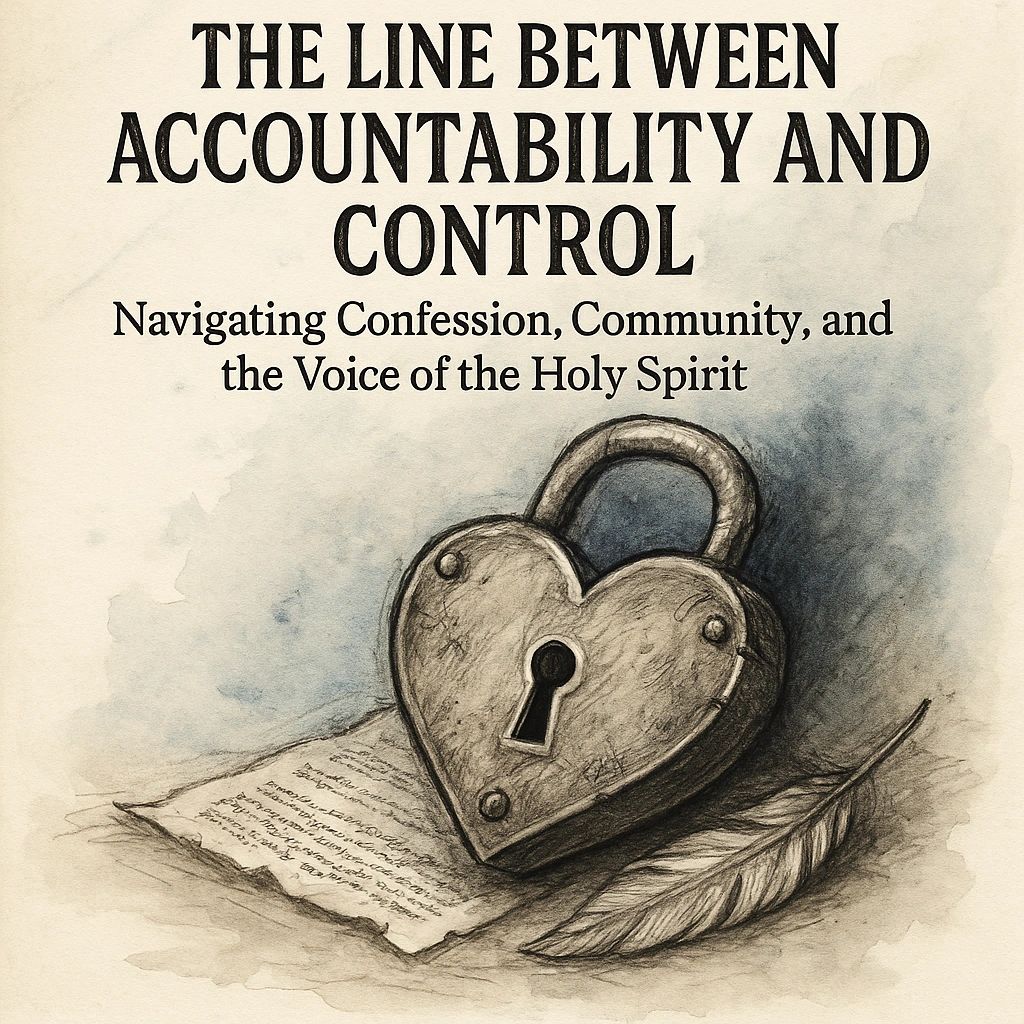
The Line Between Accountability and Control
Navigating Confession, Community, and the Voice of the Holy Spirit
This is Part 2 of a three-part series on spiritual manipulation, confession, and control in high-demand church and recovery cultures.
If you haven’t read Part 1, go back and start there—it lays the foundation for everything we unpack in this post.
Now let’s dig deeper into what the Bible actually says about confession, accountability, and spiritual freedom.
Coming next:
You won’t want to miss it— subscribe now so you’re ready when it drops.
🛑 Disclaimer:
This post isn’t an attack on any one church, recovery center, or leader.
It exposes documented patterns of spiritual control seen in high-demand religious systems, based on:
survivor testimony
expert research
and public documentaries
If it feels familiar, that doesn’t make it personal—it means it’s a pattern.
If you’re reading with defensiveness, I invite you to keep reading with discernment.
Truth sets free. Shame silences.
This is for the ones still trying to find Jesus beneath the noise.
📚 Documented Patterns of Spiritual Control
These real-world examples reflect the same patterns addressed in this post:
The Way Down: God, Greed, and the Cult of Gwen Shamblin (HBO Max)
A look at Remnant Fellowship, a ministry marked by extreme control, image obsession, and spiritual manipulation.
Keep Sweet: Pray and Obey (Netflix)
Covers the FLDS under Warren Jeffs and how fear and performance shaped every part of community life.
Shiny Happy People: Duggar Family Secrets (Amazon Prime)
Explores IBLP and how Bill Gothard’s teachings built a culture of fear-based obedience. Jinger Duggar Vuolo later deconstructed this ideology in Becoming Free Indeed.
Scientology and the Aftermath (A&E, with Leah Remini)
Highlights how surveillance, forced confessions, and performance metrics were disguised as spiritual maturity.
The BITE Model of Authoritarian Control (Steven Hassan, FreedomOfMind.com)
A tool for recognizing coercion through Behavior, Information, Thought, and Emotional control—used by cult experts and applicable in toxic ministries.
It starts gentle. Like someone holding your hand so you don’t fall behind. But over time, the grip tightens—and you’re not walking with them anymore. You’re being led.
“You were running a good race. Who cut in on you to keep you from obeying the truth?”
— Galatians 5:7
This is for the ones who walked into a church or ministry looking for healing—and walked out more confused, ashamed, or silenced than before.
For the spiritually sensitive.
The recovering rule-followers.
The ones who stayed longer than they should have because they thought leaving meant disobeying God.
Controlling religious environments are on the rise.
We see it in documentaries, headlines, testimonies.
But this post isn’t about one place.
It’s about a pattern.
Because when you’re spiritually vulnerable, you’ll cling to anything that promises clarity.
Even if it costs you your voice.
Even if it convinces you to trade discernment for blind obedience.
🔥 You Were Obeying and Still Got Burned
Obedience to Jesus leads to freedom. Obedience to fear-based systems—especially when they use God’s name—leads to bondage.
“He will not break a bruised reed or quench a smoldering wick.”
— Isaiah 42:3
You weren’t in rebellion.
You were obeying what you thought was God.
You were showing up, staying loyal, trying your best to follow the rules.
But the system wasn’t built to lead you to freedom. It was built to protect itself.
Someone close to you hid something out of fear—fear of how the truth would be received. Because when confession leads to punishment instead of grace, secrecy starts to feel safer than honesty.
And when you finally asked for support, you weren’t met with prayer or care.
You were met with surveillance.
With distance.
With whispers about you instead of comfort for you.
“Carry each other’s burdens, and in this way you will fulfill the law of Christ.”
— Galatians 6:2
Instead of care, there was control.
Instead of protection, there was power.
And that’s when it clicked:
It was never about your spiritual growth.
It was about preserving a structure.
🧠 When “Accountability” Becomes a Control Tactic
“Where the Spirit of the Lord is, there is freedom.”
—2 Corinthians 3:17
Biblical accountability is rooted in love, not fear.
In restoration, not exposure.
In truth, not control.
But in many high-control religious and recovery spaces, accountability starts to feel like surveillance.
One phrase used everywhere in recovery culture is:
“Secrets will get you high.”
And while secrecy can absolutely isolate and feed shame, that phrase is often weaponized.
Instead of helping people heal, it pressures them to confess things they’re not ready to share.
It makes silence feel sinful.
And it turns peers into informants.
We were told that if we kept someone’s secret, they might relapse.
That if we didn’t speak up, it could cost them their life.
So we confessed what wasn’t ours to confess.
Not because the Holy Spirit led us, but because we were scared of being responsible for someone else’s fall.
That wasn’t conviction. That was conditioning.
Conviction is led by the Holy Spirit, who brings truth with love and clarity. Conditioning is rooted in fear, and it bypasses the heart in exchange for compliance.
We were taught that silence was dangerous.
That having information meant we were obligated to expose it.
That someone else’s struggle was now our responsibility.
So we shared, not out of love, but out of fear.
We didn’t want to “get high from keeping secrets.”
We didn’t want to lose leadership’s approval.
We thought we were protecting someone.
But really, we were protecting the system.
Because real accountability doesn’t force disclosure.
It creates safety for honesty.
It doesn’t say, “Tell me now or else.”
It says, “You’re safe here when you’re ready.”
We thought we were doing what Jesus would do.
But fear was leading us—not love.
And Jesus doesn’t lead through fear.
“Brothers and sisters, if someone is caught in a sin, you who live by the Spirit should restore that person gently.”
—Galatians 6:1
⚖️ Integrity Does Not Mean Full Exposure
“Above all else, guard your heart, for everything you do flows from it.”
— Proverbs 4:23
We were taught that integrity meant transparency. That being honest required telling everything. That withholding information—even personal pain—meant you were hiding, deceiving, or slipping spiritually.
But here’s the truth:
Integrity means keeping your word.
It means living with honesty, yes. But not at the expense of discernment.
It does not mean handing over every thought, every emotion, every sacred thing to people who demand access.
Especially when those people give no access back in return. It’s a one-way street disguised as mutual support.
It starts to feel like a confessional, but not the kind where grace meets honesty. More like a one-way booth where vulnerability becomes spiritual leverage. Confessing not to God, but to people who treat themselves like saints. And if you don’t hand over enough, you’re questioned. Pressed. Labeled. Watched.
I confessed a lot of things to someone I still barely know anything about, and what that did was open me up spiritually to someone who never truly opened up to me. I still don’t know what she actually thought of me, apart from the moments she was correcting me. That kind of one-sided vulnerability doesn’t build trust; it builds confusion. And eventually, it breeds spiritual dependency disguised as accountability. I spilled my soul to someone who only spoke up to critique me, never to actually know me. Then I sat in the aftermath, wondering what I was doing wrong, even though the system said I was doing everything right.
But let’s check that biblically. Because the Bible does call us to confession, and it’s incredibly important.
📖 What the Bible Actually Says About Confession
When confession is Spirit-led and mutual, it brings healing.
When it’s demanded to maintain power or appearances, it brings confusion and shame.
1. Confession is mutual. Not hierarchical.
“Confess your sins to one another and pray for one another, that you may be healed.”
— James 5:16
This doesn’t say confess to your leader so they can monitor you. It says one another.
Mutual. Safe. Prayerful. Healing, not humiliation.
2. Confession flows from the Spirit. Not fear.
“There is no fear in love. But perfect love drives out fear, because fear has to do with punishment.”
— 1 John 4:18
If you’re only confessing because you’re scared of the consequences, that’s not conviction. That’s control.
3. Jesus is our High Priest. Not man.
“For there is one God and one mediator between God and mankind, the man Christ Jesus.”
— 1 Timothy 2:5
Yes, we confess to one another. But we are not saved, healed, or restored by leadership.
Jesus is the one who forgives. The one who restores. The one who sees every hidden place and still loves us into wholeness.
4. Accountability includes boundaries.
“Each of us will give an account of ourselves to God.”
— Romans 14:12
You are responsible for yourself. Not someone else’s emotions. Not leadership’s comfort level.
And not every detail is a spiritual danger just because it wasn’t immediately disclosed.
So yes. Confession matters.
Accountability matters.
But so does discernment.
You don’t owe your entire soul to people just because they have authority.
You don’t need to spill sacred things just to be seen as honest.
You don’t owe your voice to anyone just because they want access.
Discernment is holy.
Boundaries are biblical.
And Jesus never coerced confessions. He invited honesty through love.
Biblical confession is never about control. It is about healing, humility, and unity in the Body of Christ.
Real confession feels like sunlight hitting a wound—not to shame it, but to cleanse it. It hurts, but it heals. It exposes, but it also restores.
😔 When Community Turns into Conformity
“Do not conform to the pattern of this world, but be transformed by the renewing of your mind.”
— Romans 12:2
Some churches and ministries didn’t start as controlling.
They slowly shifted when structure replaced Spirit, and image became more important than intimacy.
At first, it was about God.
Then it became about the grind.
About perfection. Performance. Publicity.
In the FLDS church under Warren Jeffs, conformity wasn’t just encouraged, it was demanded. Every part of life was about performance, appearance, and blind obedience.When that same obsession starts to echo in churches, even wrapped in words like ‘excellence’ or ‘order,’ it’s worth asking what’s really driving it.
Not every ministry is a cult.
But if the fruit looks the same, and when you shared what the Holy Spirit was showing you they dismissed it and called you the problem, that should not be ignored. That is a red flag.
“Having a form of godliness but denying its power. Have nothing to do with such people.”
— 2 Timothy 3:5
You weren’t being rebellious.
You were just the first to notice something was off.
⚠️ Even the Church Isn’t Exempt from Cult Behavior
“Beware of false prophets… By their fruit you will recognize them.”
— Matthew 7:15–16
Spiritual control hides in plain sight.
Not in the form of rebellion, but in over-polished obedience.
In flawless testimonies and fear-based loyalty.
In systems that run on hype and hierarchy instead of the Holy Spirit.
In Scientology, members are encouraged to present perfect “wins” and positive testimonies. Struggles are hidden. Doubt is punished. Sound familiar? When image becomes more important than honesty, a system becomes spiritually toxic—even if it claims the name of Jesus.
“The thief comes only to steal and kill and destroy; I have come that they may have life, and have it to the full.”
— John 10:10
Not every system that says “God is here” is actually letting God lead.
💔 This Isn’t a Call to Leave. It’s a Word for the Ones Who Were Left.
“My sheep listen to My voice; I know them, and they follow Me.”
— John 10:27
This isn’t a takedown.
It’s a mirror.
It’s not an attack on the Body.
It’s a light aimed at infected areas that occupy so many church groups.
Because healing can’t come where no one’s willing to look.
I’m not calling anyone to walk away.
That call belongs to Jesus alone.
But I am speaking to the ones who were already pushed out.
The ones still trying to untangle God’s voice from the ones that hurt them.
The ones who were told to hide their struggles instead of heal them.
Who were discarded under the justification of “protection” in the name of Jesus.
If that’s you, you’re not crazy.
You’re not rebellious.
And you’re not alone.
🍎 “You Will Know Them by Their Fruit.” — Matthew 7:16
“But the fruit of the Spirit is love, joy, peace, forbearance, kindness, goodness, faithfulness…”
— Galatians 5:22
Look for fruit that looks like Jesus.
Not:
• Fear
• Control
• Hype over holiness
• Loyalty to man over intimacy with God
But:
• Love that protects
• Joy that’s not manufactured or performed
• Peace that doesn’t require pretending
• Humility that leaves space for God’s leading
✅ What Healthy Community Looks Like:
• You’re invited, not coerced
• You can ask hard questions and they lead you closer to Christ
• Correction is done in love, not ego
• Your freedom is protected
• Your growth is celebrated, even if it leads you elsewhere
• You feel seen, not surveilled
“Let all that you do be done in love.”
— 1 Corinthians 16:14
🚫 What Cult-Like Community Looks Like
• You're punished or alienated for asking questions
• Correction is public, shaming, and always top-down
• Leaders are expected to appear perfect. They only share polished, acceptable stories from their past. These are struggles they’ve supposedly overcome, because they know the cost of showing real, current weakness. Anything that doesn’t fit the picture-perfect mold gets tucked away. The second they mess up and need to be discarded, that hidden mess is dragged out and used against them.
• Leaving is framed as rebellion, not release
• You're told that staying keeps you safe. Leaving means spiritual death.
• If you try to return, you're expected to beg for acceptance. You're also required to go through a restoration process that is less about healing and more about humiliation. It is presented as humility.
These traits are seen in everything from Remnant Fellowship to FLDS to certain high-control recovery ministries. The names change. The methods don’t.
Not every church is like this. Not every leader controls.
There are healthy communities that protect freedom, honor questions, and reflect the heart of Jesus.
But if this pattern sounds familiar, you’re not crazy. You are not the only one who’s seen it.
🧠 Final Word: Discernment Is Not Rebellion
“But you have an anointing from the Holy One, and all of you know the truth.”
— 1 John 2:20
“The anointing you received from Him remains in you… His anointing teaches you about all things.”
— 1 John 2:27
You don’t need permission to hear God for yourself.
Let go of the guilt.
Keep your discernment.
And know that your obedience belongs to Jesus, not to systems, structures, or spiritual figureheads.
“Test everything. Hold fast what is good.”
— 1 Thessalonians 5:21
⛪ Don’t Give Up on Church. Go Find the Right One.
Being hurt by church doesn’t mean God wants you to stay out of community.
Jesus designed us to be part of His Body. That includes spiritual family, real connection, and a church that reflects His heart.
Not every church is controlling. Not every leader is performing. There are healthy communities out there, full of grace, truth, love, and help. But you may have to explore a little to find them.
So do not settle for silence or isolation. Visit different churches. Sit in the back if you need to. Ask God to show you where He wants you planted. Look for fruit that looks like Him. Listen for peace. Watch how they treat people who are struggling. You will know.
The goal is not perfection. The goal is presence. Community that makes room for both conviction and compassion. A place where you do not have to pretend in order to belong.
Jesus wants you connected, covered, encouraged, and known.
There is a place for you. Keep looking until you find it.
Bring a friend if you need support. God often confirms direction in community.
Recovery & Reflection Questions
If you’re still in a church or ministry and you’re wrestling with some of this, please hear me: this isn’t a call to walk away. It’s a call to pay attention.
And if you were pushed out, silenced, or spiritually dismissed—I’m not trying to deconstruct your faith. I’m trying to help you find Jesus again beneath all the noise.
Use these to process with the Lord, a counselor, or someone safe:
1. When have I confused control with accountability?
2. What “obedience” have I been performing out of fear instead of faith?
3. Where am I still trying to earn safety through spiritual behavior?
4. Have I confused community with conformity?
5. What does freedom in Christ actually look like for me today?
📖 Scripture Note:
All Scripture quoted is from the [NLT] unless otherwise noted.
Disclaimer:
This blog post is based on my personal experiences, reflections, and spiritual insights. It is not intended to defame or harm any individual or organization. All descriptions are personal opinion and perception, and no names or identifying details have been shared.
About the Author
Candace Lane is a seer, prophetic scribe, faith-based writer, and founder of Holy Grit. She went from atheist and addict to truth-teller and spiritual guide, writing with the fire of someone who has lived every line.
Her story includes addiction, motherhood, recovery, deliverance, and obedience. But her voice is rooted in discernment and deep intimacy with Jesus. She writes for the spiritually sensitive, the misunderstood, and the ones who don’t fit in traditional church boxes.
Through blogs, devotionals, and raw testimony, Candace helps readers recognize God’s voice, heal from religious manipulation, and walk boldly in their calling.
Don’t just read it—walk it out.
Every email is a reminder that grace is still stronger than fear.
If that’s where you are—on the edge of something new but unsure how to take the next step—I’d be honored to walk with you.
👉 Click here to reach out or start a conversation.
You’re not crazy. You’re not alone. And you don’t have to figure this out by yourself.
📩 Message me here when you’re ready.
If your spirit is stirring and you’re unsure what to do next—let’s talk.
Grab one of my resources to help you walk it out:
📝 5 Days of Holy Grit – Portable prompts for when grace feels far away and you need a comeback.
🙏 Recovery Prayer Pack – Five powerful prayers for the days shame won’t shut up.
And if you’re still carrying what Jesus already died to take…
🧰 Resources for the Spiritually Sensitive
Support & Healing Tools:
• Trauma-Informed Christian Counselors:
• Open Path Collective (search by faith-based + trauma-informed)
• Faithful Counseling
• Restoration Counseling
Support Groups:
• The Reclamation Collective
• Spiritual Abuse Resources
• The Body Keeps the Score Workbook (for personal recovery)
Free Tools to Download:
Before You Go
If this post met you somewhere, let’s stay connected. I go even deeper on Substack, and you can listen to the Letters From a Christian Seer podcast on Apple Podcasts. New here? Read my story.
Building something of your own? See how we can work together.
Keep Reading
Healing Doesn't Have to Happen Alone
Join the Holy Grit email list for gentle weekly letters for anyone rebuilding faith after church hurt. Space to pray, reflect, and hear God for yourself again.
If you came for the deep end, thanks for wading in. And if God's also nudging you to build something, I made a free LLC checklist to get you started. When you're ready for the full walkthrough, there's the $27 LLC guide, and a $47 LLC Guide Walkthrough Call if you get stuck.